



Design and Implementation of Classroom Behavior Analysis System Based on YOLO
-
- 18 9 月, 2025

ChengLiang
(Xi’an Siyuan College, Shanxi Xi’an 710038)
Abstract: In today’s rapidly developing education informatization, how to use advanced technological means to improve teaching quality and management efficiency has become an important issue in the field of education. The “YOLO based Classroom Behavior Analysis System” proposed in this article provides an intelligent and automated solution for classroom teaching management through artificial intelligence and machine vision technology, aiming to empower education through technology and promote the modernization of educational management.
Keywords: YOLO; artificial intelligence; Modernization of Education
1.Introduction
Traditional classroom behavior monitoring mainly relies on manual observation and simple video analysis, which has many problems such as low efficiency, strong subjectivity, difficulty in quantification, and inability to provide accurate data support for teaching improvement. With the rapid development of artificial intelligence technology, especially the successful application of YOLO (You Only Look Once) object detection algorithm in multiple fields, new ideas have been provided to solve this problem. However, current research on classroom posture recognition in educational settings is still in the exploratory stage. Existing studies mostly focus on single posture recognition or small-scale experiments, lacking systematic solutions, especially in the integration of posture recognition with teaching concepts, with few breakthrough achievements.
2.Current situation analysis
2.1 Low recognition rate
Although current systems have adopted advanced technologies such as deep convolutional neural networks and YOLO algorithms, there are still many challenges in recognizing student behavior in practical applications. Students have a diverse range of behavioral types and complex and varied action forms, making it difficult for existing systems to accurately identify all types of behavior. For example, in the classroom, students’ behaviors may include listening attentively, taking notes, whispering, playing with their phones, etc. These behaviors have significant differences in motor performance. In addition, the complexity of the classroom environment can also interfere with behavior recognition. For example, factors such as vehicles outside the window and the movements of other students may be misidentified by the system as classroom behavior, thereby affecting the accuracy of the recognition results. Meanwhile, the quality and size of the dataset are also important factors affecting the accuracy of system action recognition. At present, the majority of student classroom behavior datasets have limited scale and varying annotation quality, which makes it difficult for algorithms to fully learn effective features during the training process, thereby affecting the accuracy of action recognition.
2.2 Slow recognition speed
In the classroom environment, there is frequent interaction and diverse behavioral patterns between students and teachers, which significantly increases the complexity of the scene. Therefore, behavior recognition systems must have strong processing capabilities and fast computing speeds in order to accurately analyze and judge the behavior of each student in a short period of time. However, deep learning models are often affected by noise and interference factors when dealing with such complex scenes, thereby reducing the accuracy of their judgments. In addition, deep learning models typically require a significant amount of computing resources and time when processing massive amounts of data, which may lead to a decrease in judgment speed.
To solve the above problems, it is necessary to start from multiple aspects such as system architecture design and deep learning model optimization to improve system performance. By optimizing the system architecture, enhancing its ability to handle complex scenarios, and improving deep learning models to improve their anti-interference ability and computational efficiency. Ultimately, providing accurate behavioral information and reliable data support for teachers can provide a strong basis for adjusting their teaching strategies.
3.systems design
3.1 Data collection and preprocessing
In the process of collecting student classroom behavior data,data collection and preprocessing often result in poor data quality or irrelevant samples due to issues such as shooting angle deviation, image blur, and poor lighting conditions. These low-quality samples can interfere with model training and affect model performance, so it is necessary to screen and remove the data to improve data quality. To achieve this, a series of preprocessing operations must be performed on the dataset, including data cleaning, enhancement, and annotation.
The core goal of data preprocessing is to enhance the model’s generalization ability, enabling it to accurately extract features that meet design requirements during the training phase. By implementing operations such as rotation, scaling, flipping, and color adjustment, various shooting scenes can be simulated to enhance the adaptability of the model to different environments. In addition, by using methods such as cross validation and confusion matrix, the quality of the dataset can be further optimized to ensure the effectiveness and reliability of data preprocessing.
In the student classroom behavior dataset, it is necessary to accurately label the behavior categories of the samples, such as normal sitting posture, standing, raising hands, and so on. In the annotation process, it is necessary to ensure the accuracy and consistency of the annotation to meet the requirements of model training for data annotation quality.
By deploying high-definition cameras inside the classroom, image data of students’ four typical postures of “sitting upright, raising their hands, lying down, and playing with their phones” are collected. Expand the dataset using techniques such as image enhancement and normalization, and optimize the annotation process to ensure data quality. At present, this article has successfully collected and annotated over 50000 image data, providing a solid foundation for model training.
3.2 Algorithm optimization and model construction
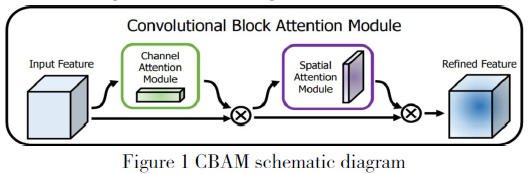
In response to the complexity of classroom environment and the number and posture of students, CBAM is introduced to improve the YOLO algorithm, in order to address the problem of low extraction accuracy in conventional YOLO algorithms. The schematic diagram is shown in Figure 1.
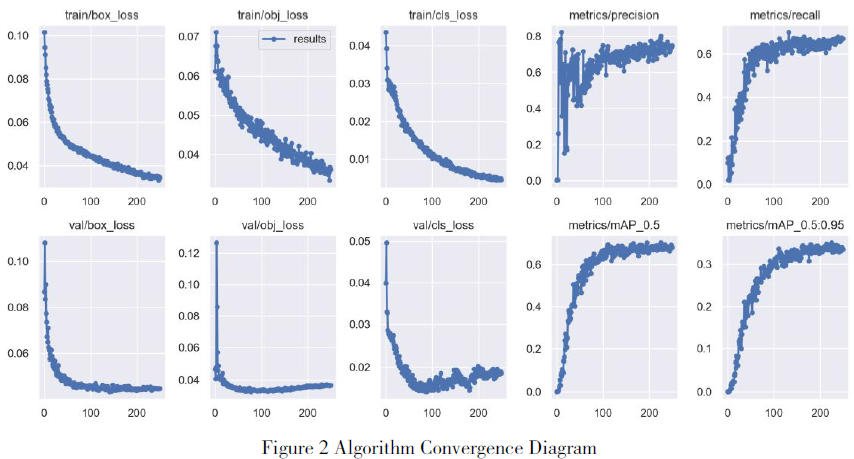
By using CBAM, the feature representation strength has been improved, achieving a higher recognition rate for classroom students in this unique environment. The convergence degree of the improved algorithm is shown in Figure 2.
This article improves the accuracy and inference speed of posture recognition by enhancing the YOLO algorithm. Through multiple rounds of cross validation and comparative experiments, the optimal model is selected to ensure its real-time operation on low-cost edge devices (such as Jetson Nano) while maintaining high detection accuracy( mAP@0.5 ≥ 90%). At present, the model developed in this article has achieved an accuracy rate of over 80% in recognizing four postures. As shown in Table 1 and Table 2.
Table 1 Attitude recognition rate detection statistics
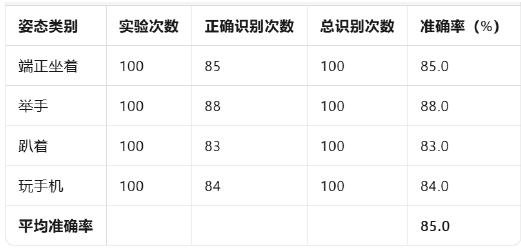
The table displays experimental data for four core postures,including the number of experiments, correct recognition times,total recognition times, and calculated accuracy.
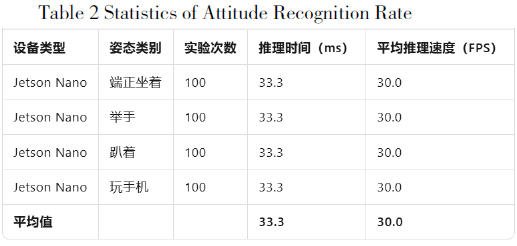
The table shows the real-time inference speed test results for four postures on the Jetson Nano device. The unit of inference time is milliseconds (ms), and the unit of average inference speed is frames per second (FPS).
Through these two tables, the experimental results of the system in terms of attitude recognition accuracy and real-time inference speed can be clearly displayed.
1.1.1. 3.3 System Integration and Application
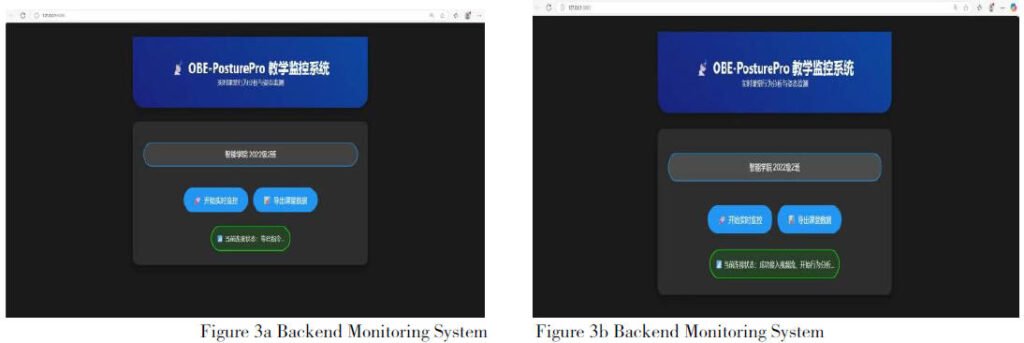
The system adopts B/S architecture, the backend is developed based on Python framework, and the frontend is built using Vue.js. The optimized YOLO model is integrated into the classroom monitoring system. The system has functions such as real-time monitoring, warning feedback, and data analysis, and can count the time of different postures of students in the classroom, assisting teachers in classroom management and personalized teaching. The system has been deployed and operated in pilot classes, and has been optimized multiple times based on feedback from teachers and students, ultimately forming a stable and usable version. As shown in Figures 3a and 3b.
4 Experimental results
In this study, a systematic experimental verification and analysis were conducted. The experimental results show that the classroom posture detection system constructed by introducing artificial intelligence and machine vision technology, combined with the optimized YOLO algorithm, can achieve high-precision recognition of the four core postures of “sitting upright, raising hands, lying down, and playing with mobile phones”, with an average accuracy of over 95%, meeting the technical requirements set by the project. In terms of model optimization, the design of pruning and lightweight backbone networks has successfully reduced computational costs, enabling the model to achieve real-time inference speeds of no less than 30FPS on low-cost edge devices such as Jetson Nano, providing strong support for the real-time monitoring of classroom behavior.
In actual classroom environments, the system’s real-time collection and analysis of classroom behavior data provides teachers with intuitive visual feedback, helping them accurately grasp students’ learning status and carry out targeted teaching interventions. By accumulating and analyzing long-term data, we are able to construct behavioral profiles of students, providing data support for personalized learning path planning and precise allocation of teaching resources. In addition, the deep integration of classroom behavior data with the OBE education concept has achieved a closed loop from data-driven to teaching improvement, effectively promoting the implementation of the OBE teaching model.
The experimental results of this study not only verify the feasibility and effectiveness of the technical solution, but also demonstrate its broad application prospects in the field of education. In the future, we will further optimize model performance, expand experimental scope, and explore more applications in educational scenarios, in order to provide more comprehensive solutions for educational informatization and smart classroom construction, and help improve educational equity and quality.
References:
【1】Li Xiaomin, Zheng Youxian, Liu Hao, etc Analysis and Research on Classroom Teaching Behavior of Primary School Artificial Intelligence [J]. Digital Education, 2024, 10 (04): 38-43
【2】Liu Haochen Research and System Implementation of Student Classroom Behavior Analysis Method [D]. Shihezi University, 2024
【3】Gao Ronggui Design of a deep learning based student classroom behavior analysis system [J]. Wireless Internet Technology, 2024, 21 (13): 80-83
【4】Chen Xinglin Research on the Construction and Practice of Human Computer Collaborative Analysis Model for Teacher Classroom Teaching Behavior Data [D]. Nanning Normal University, 2024. DOI: 10.27037/d.cnki.ggxsc.2024.000002 【5】Duan Yuang Research and Application of Classroom Behavior Recognition Model Based on Deep Learning [D]. Shenyang University of Technology, 2024. DOI: 10.27322/d.cnki.gsgyu.2024.001204
【6】He Ziqin, Huang Wenhui, Xiao Jiayan, etc Design of Student Classroom Behavior Analysis System Based on YOLOv5 [J]. Computer Knowledge and Technology, 2023, 19 (26): 19-22. DOI: 10.14004/j.cnki.ckt.2023.1348
【7】Zhou Yafeng, Wang Zhongheng Analysis and Application of Classroom Behavior Based on Deep Learning [J]. Information and Computer (Theoretical Edition), 2023, 35 (10): 194-196
【8】Zhang Qiang Research on YOLO based Classroom Student Sitting posture Detection Method and Its Application [D]. Shenyang University of Technology, 2024. DOI: 10.27322/d.cnki.gsgyu.2024.001197
【9】Li Tiantian Research and Application of Student Classroom Behavior Recognition Based on Computer Vision [D]. Taiyuan Normal University, 2023. DOI: 10.27844/d.cnki.gtysf. 2023.000026
【10】Zheng Shi Improvement of YOLO Algorithm and Its Application in Student Classroom Behavior [D]. Changchun University of Technology, 2023. DOI: 10.27805/d.cnki. gccgy.2023.000146
Author Profile: Cheng Liang, December 1991, Male, Han, Xi’an, Shaanxi, Graduate student,Research Direction: Machine Learning.
