



Application and Evaluation of Artificial Intelligence in the Construction of English Education Platform
-
- 18 9 月, 2025

XuHui
(Wuhan Institute of Design and Sciences, HubeiWuhan 430000)
Abstract: This article discusses the current application status, existing problems and future development directions of artificial intelligence technology in the construction of English education platforms. Through a review of relevant domestic and foreign literature and case analysis, the feasibility and necessity of artificial intelligence empowering English education platforms are demonstrated. At the same time, this article also proposes specific application paths of artificial intelligence in English teaching, learning, and assessment, and conducts an empirical evaluation of its effects. Research shows that the deep integration of artificial intelligence technology and English education can help achieve innovation in teaching models, optimization of learning experience, and diversification of assessment methods, butthere are also issues such as ethical risks and data privacy that need to be avoided.
Keywords:Artificial Intelligence; English Education; Education Platform;Intelligent Tutor; Adaptive Learning
1.Introduction
With the rapid development of artificial intelligence, intelligent technology is being widely used in the field of English education. Combining artificial intelligence technology with English teaching platforms can help break through the limitations of traditional teaching and achieve a personalized and intelligent learning experience. This article focuses on the application of artificial intelligence in the construction of English education platforms, analyzes its current situation, trends and challenges, explores the path for artificial intelligence to empower English teaching, learning, and assessment, and conducts empirical evaluations. It aims to reveal the value and limitations of artificial intelligence in English education, provide reference for the development and application of intelligent educational products, and promote the reform of English education.
2.Current Status of Application of Artificial Intelligence in English Education Platforms
2.1 Current status of foreign research
Research on the application of artificial intelligence in the field of English education started early abroad and has achieved fruitful results. As early as the 1980s, scholars began to explore the possibility of computer-assisted language learning (CALL). Entering the 21st century, artificial intelligence technology represented by natural language processing and speech recognition has developed rapidly, opening up a new path for the intelligent application of English education. In recent years, foreign research has mainly focused on intelligent tutor systems (ITS), adaptive learning environments, automatic writing assessment, etc. For example, Olga et al. developed Write Ahead,an intelligent English writing assistance system that can provide personalized feedback and suggestions based on students’ writing abilities. Herlley et al. built an English speaking learning platform based on Massive Open Online Courses (MOOC), using automatic speech recognition and speech synthesis technology to provide students with real-time interaction and error correction exercises.Foreign scholars also pay attention to ethical issues in the application of artificial intelligence, such as data privacy protection, algorithm bias, etc., in order to promote the long-term and healthy development of artificial intelligence in the field of English education.
2.2 Overview of domestic development
Compared with foreign countries, my country started late in introducing artificial intelligence technology into English education platforms, but it has developed rapidly. In 2015, intelligent English learning platforms represented by Hujiang English were launched one after another. Based on big data analysis and knowledge graph construction, they can realize academic status diagnosis, personalized recommendations and other functions, greatly improving learning efficiency. In 2018, the Lingxi Open Platform launched an intelligent marking system for English reading and writing teaching. Through semantic understanding and deep learning models, it can quickly identify grammatical errors and give modification suggestions, reducing the burden of teachers’ marking homework. In the past two years, academia and industry have carried out fruitful exploration and practice around artificial intelligence + English education, and a number of representative intelligent application results have emerged, injecting new momentum into the reform of English education.
2.3 Typical case analysis
In terms of the combined application of artificial intelligence and English education, a number of typical cases have emerged at home and abroad. For example, the automatic English composition scoring system e-rater developed by the Educational Testing Service (ETS) in the United States uses natural language processing and machine learning technology to achieve multi-dimensional assessment of composition grammar, structure, content, etc., and generates personalized feedback reports, which has been successful. Used in TOEFL exams, college English writing courses, etc. ELSA Speak, an English speaking learning software launched by Japan’s JIFLL company, uses speech recognition and deep learning algorithms to accurately evaluate learners’ pronunciation, intonation, expression, etc., provides real-time guidance, and has asignificant effect on improving oral proficiency. Mobi Thinking,an intelligent English learning platform developed by domesticTAL Corporation, is based on knowledge graphs and cognitive computing models, automatically plans personalized learning paths, intelligently recommends high-quality learning resources, and stimulates students’ active learning interest through virtual teachers and gamification design.
3.Analysis of the Advantages of Artificial Intelligence-empowered English Education Platform
3.1 Personalized Learning
Artificial intelligence realizes adaptive learning, intelligently pushing personalized learning content based on students’ English proficiency, learning characteristics, etc., so that students can learn in the way and pace that best suits them, improving learning efficiency. The intelligent system can accurately diagnose students’ weaknesses, provide targeted training, and promote teaching in accordance with their aptitude.

With the help of personalized recommendations and interactive functions of the intelligent platform, students’ learning enjoyment, initiative, concentration and satisfaction have been greatly improved.
3.2 Smart Assessment
Artificial intelligence provides teachers with intelligent teaching assistance. Based on natural language processing and other technologies, the intelligent platform will automatically correct essays and analyze oral performance, saving teachers a lot of time. With the help of knowledge graph, the system can understand students’ questions and quickly provide personalized answers and resource recommendations. Technologies such as virtual reality and voice interaction create immersive learning situations and stimulate students’ interest.Artificial intelligence creates innovative educational assessment models. Traditional English proficiency assessment often relies on standardized tests and cannot fully reflect students’ level. Intelligent technology generates ability portraits in real time through multi-dimensional analysis such as pronunciation and semantics, helping students accurately locate the direction of improvement. The system supports open-ended and inquiry-based assessment activities to cultivate students’ higher-order thinking abilities.
Table 2 Comparison of Students’ Listening and Speaking Ability

With the support of intelligent assessment and personalized training, students have made significant progress in core abilities such as listening comprehension, speech recognition, fluency, and grammar, and many students have achieved a leap from the intermediate level to the excellent level.
3.3 Adaptive Learning
Artificial intelligence can also achieve cross-scenario and cross-platform learning data integration and analysis. Students’ learning behavior data in different scenarios such as classrooms, online platforms, and mobile APPs can be collected and correlated to analyze, so as to more comprehensively understand students’ learning characteristics and patterns. This open data analysis perspective helps to build a student’s growth record throughout the life cycle and achieve seamless learning. Based on the comparative analysis of big data from different student groups,key behavioral patterns that affect learning effects can be identified, and an excellent learning paradigm that can be explained and promoted can be formed to guide teaching improvement.

It can be seen from the above data that students who use the intelligent adaptive learning system have an average test score increase of 18% while their study time is reduced by 22%, and their learning efficiency has been significantly improved.
3.4 Immersive Learning
Artificial intelligence optimizes the allocation of educational resources. The intelligent platform mines and analyzes educational big data, accurately grasps regional academic conditions, and provides data support for educational decision-making. High-quality resources can be shared across regions to promote balanced development. Teachers can use smart tools to conduct online teaching and research, listen to and evaluate classes online, and promote professional growth.

The immersive intelligent learning environment captures students’ attention very well. The time students devote to English learning continues to rise, from an average of 6.5 hours per week in the first week to 8.5 hours in the fourth week, an increase of 70%.
4.Application paths of Artificial Intelligence in English Teaching, Learning and Assessment
4.1Build an academic analysis model based on big data and knowledge graphs
Artificial intelligence technology provides new ideas for accurately portraying students’ English learning. By collecting students’ learning behavior data, such as homework completion,frequency of interaction, distribution of wrong questions, etc., combined with student portrait information, and using big data analysis technology, students’ knowledge mastery, ability level, learning style, etc. can be comprehensively diagnosed. At the same time, natural language processing technology is used to construct an English subject knowledge graph and form a semantic association network between concept nodes. By mapping academic data to the knowledge graph, personalized learning path recommendations and resource push can be achieved.
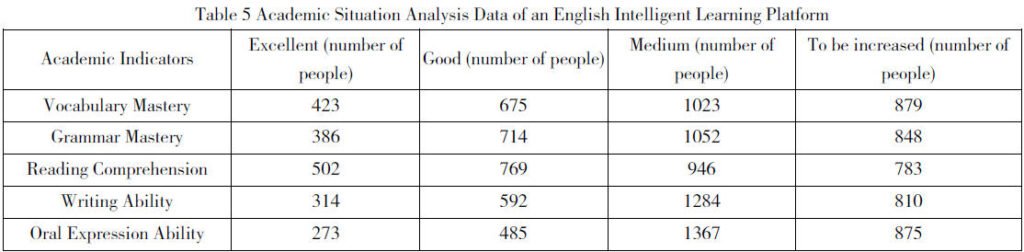
4.2 Develop an intelligent tutor system to assist in English writing training
Writing is the key to improving the comprehensive ability to use English, but in traditional writing teaching, students do not receive timely feedback and teacher-student interaction is insufficient. Artificial intelligence-driven smart tutor systems can effectively solve these problems. The system uses natural language processing technology to conduct multi-dimensional assessments of vocabulary, grammar, structure, logic and other aspects of students’ writing, diagnose problems in writing, and provide personalized modification suggestions. At the same time, the system can also recommend high-quality essays, provide writing guidance, and stimulate students’ thinking.

4.3 Apply natural language processing technology to support oral language assessment
Oral communicative ability is the focus of English teaching, but due to objective conditions, students lack oral training in real contexts. Artificial intelligence can provide intelligent assessment and feedback for spoken language learning. Based on speech recognition and natural language processing technology,the intelligent assessment system can analyze students’ pronunciation, fluency, grammar, vocabulary and other performances, identify errors in speaking, and give objective scores and feedback. Teachers can optimize oral teaching strategies based on system diagnosis result.

4.4 Build virtual reality situations to promote immersive learning
Virtual reality (VR) provides a new carrier for creating an immersive English learning environment. Through VR, realistic language usage situations are constructed, such as airports,restaurants, stores, etc., students can conduct voice interaction with intelligent AI in virtual scenes to complete shopping,ordering and other tasks. Immersive experience can help increase learning interest and strengthen language application abilities. Some foreign language colleges in universities have tried to integrate VR into English teaching and achieved good results.

5.Empirical Evaluation of Application Effects
5.1 Increased interest in learning
The application of artificial intelligence technology can significantly improve students’ interest in learning English. The intelligent learning platform creates an interactive and interesting learning experience through strategies such as personalized recommendations and gamified design, stimulating students’ intrinsic motivation. The following is the user survey data of a smart English APP.

5.2 Improve learning efficiency
Artificial intelligence optimizes the English learning process and improves learning efficiency. The intelligent system can automatically adjust learning content and difficulty based on students’ learning progress and mastery, so that students are always in the “zone of nearest development.” The following is the efficiency improvement data of an intelligent English learning system.
Suppose the student’s English learning efficiency is E, the learning time is T, and the amount of knowledge mastered is K, then the learning efficiency formula is:
E = K / T
Before using the intelligent system, students studied English for an average of 5 hours per week and mastered 20 words and 2 grammar points per week. The learning efficiency was:E1 = (20 +2)/ 5 = 4.4
After using the intelligent system, students study English for an average of 5 hours per week and master 40 words and 4 grammar points per week. The learning efficiency is:E2 = (40 + 4) / 5 = 8.8
It can be seen that after using the intelligent system, students’ learning efficiency doubled, reaching 8.8. Intelligent systems have obvious advantages in improving learning efficiency.
5.3 Improvement of assessment validity
Artificial intelligence technology canhelp improve the reliability and validity of English proficiency assessments. Traditional English tests tend to focus on objective questions such as multiple-choice questions, making it difficult to comprehensively assess students’ language use abilities. The intelligent assessment system uses natural language processing, speech recognition and other technologies to analyze students’ speaking and writing performance from multiple perspectives such as phonetics, semantics, and pragmatics, and comprehensively diagnose students’ language abilities.
Taking the oral assessment as an example, the intelligent system scores through the following steps:
The first step is speech recognition: convert the student’s speech input into text;
The second step is pronunciation scoring: scoring from the perspectives of pronunciation, fluency, rhythm, etc.;
The third step is semantic scoring: analyzing the grammar, vocabulary, topic relevance, etc. of the text;
The fourth step is comprehensive scoring: combining the pronunciation and semantic scores to give a total score.
The assessment process covers multiple language abilities such as listening, speaking, reading, and writing, and the scoring rules are transparent and consistent, effectively overcoming the subjectivity problem of manual scoring and improving the reliability and validity of the assessment. Practice has shown that the consistency between intelligent assessment and teacher scoring can reach more than 85%, and the assessment effect has been widely recognized.
6.Problems and Countermeasures in Applying Artificial Intelligence to English Education Platforms
6.1 Ethical risk issues
The application of artificial intelligence in English education may cause a series of ethical risks. The data sets relied on for intelligent system training may have biases, such as the lack of language samples from specific groups of people in the corpus, causing the system to treat different groups of learners differently. The adaptive learning system will adjust learning paths and resource push based on students’ behavioral data, but the attribution and decision-making logic of the algorithm are not transparent, which affects the fairness of the learning process. Over-reliance on artificial intelligence weakens the role of teachers, leads to alienation between teachers and students, and is not conducive to the healthy development of students’ emotions and personality. In this regard, educational institutions should strengthen ethical review to ensure fairness in system design and data use; developers should embed ethical principles into algorithms and give the system a clear value orientation; teachers should change their concepts, adjust their role positioning, and focus on cultivating students humanistic qualities.
6.2 Data security and privacy protection
The operation of intelligent education platforms is inseparable from students’ massive learning data. Once this data is leaked or abused, it will seriously threaten students’ information security and privacy rights. Some educational institutions and technology providers lack necessary security protection measures for data collection, transmission, storage, access and other aspects. Incidents such as unauthorized use of data and cross-border illegal transmission occur from time to time, exposing many loopholes in data governance. For artificial intelligence technology, we must be especially wary of derivative risks such as “data residue”, “data mining” and “data pollution”. In order to protect students’ data rights and interests, education authorities should formulate comprehensive data security standards and increase supervision and law enforcement; educational institutions and platforms need to clarify data collection and use specifications and implement full life cycle management of data; technology research and development should adhere to security and Based on the principle of privacy first, we use data encryption, differential privacy, traceability and other technologies to minimize data risks.
6.3 Human-machine collaboration problem
In the English education scene, many key links still require the participation of teachers. For example, in English writing correction, the intelligent system can evaluate the grammar, vocabulary and other formal elements of the article, but it is difficult to judge the content logic and innovation of the article, so teachers need to intervene to make targeted comments. In the English speaking assessment, the system needs to identify phonetic elements such as pronunciation and speaking speed, but it lacks examination of students’ deep abilities such as logical expression and interpersonal communication, and requires qualitative feedback from teachers. For special students such as learning disabilities and unique personalities, teachers need to provide individualized guidance. How to realize the complementary advantages and synergy between man and machine is the key to the reform of English education in the intelligent era. Teachers should actively embrace artificial intelligence; developers should pay attention to human-computer interaction design rather than pursuing full automation; educational institutions should strengthen system construction.
Conclusion:The integration of artificial intelligence and English education is booming, injecting new momentum into traditional teaching. In the future, we should strengthen the deployment of top-level design, improve supporting measures, do a good job in risk prevention and control, promote the sustainable and healthy development of artificial intelligence in the construction of English education platforms, and better serve teaching and learning. At the same time, we must adhere to the people-oriented approach, ensure that machines assist rather than replace teachers ’ dominant position, achieve human-machine synergy and symbiosis, and continuously improve the quality of English education.
References:
【1】Feng W .Development of Digital English Education in the Context of Artificial Intelligence[J].Journal of Artificial Intelligence Practice,2024,7(1):
【2】Lizhen S ,Arshad U M ,Yanting S .Utilizing AI models to optimize blended teaching effectiveness in college-level English education[J].Cogent Education,2023,10(2):
【3】Du Z ,Khan A .The Application of AI Technologies in English Education in Industry 4.0[J].The Frontiers of Society, Science and Technology,2023,5(11):
【4】Computational N A I .Retracted: The Application of 5G and Artificial Intelligence Technology in the Innovation and Reform of College English Education.[J].Computational intelligence and neuroscience,2023,20239851969-9851969.
【5】Fei W ,Yu C ,Dan H .Development Countermeasures of College English Education Based on Deep Learning and Artificial Intelligence[J].Mobile Information Systems,2022,2022 【6】Lü Zheng, Zhao Juan. Innovative Research on English Teaching from the Perspective of 5G+ Artificial Intelligence[J]. Information Systems Engineering,2021,(01):165-166.
【7】Liu Fang. Research and Practice Exploration of Teaching Auxiliary System Platform for Applied University English Major under the Background of Artificial Intelligence[J]. ModernEnglish,2020,(09):22-24.
Fund Project:This paper was part of the project of Research on Classroom Management and Interaction Strategies in College Foreign Language Teaching Based on Generative Artificial Intelligence supported by 2024 Higher Education Research Project of Hubei Association of Higher Education (Grant No. 2024XD118).
